Some years ago, I reached out through social media to a celebrity chef/restauranteur/author and asked the most obnoxious and boring question a journeyman chef could ask. “Where do you get your ideas for dishes?”
With respect to Tim Ferriss and his “nothing ventured, nothing gained” philosophy in The 4 Hour Work Week, social media has created an atmosphere of parasocial relationships. Celebrities, influencers, authors, writers, and other famous personalities put their thoughts and ideas out into the public, and we feel a bizarre approximation of intimacy with someone we don’t know. Why else would a pastry chef from Portland, out of the blue, decide he was entitled to an answer to a fundamentally involved and idiotic question from a guy with a restaurant brand and empire to manage?
So when I got the one-word answer to my question- “Life”- my initial reaction was “Wow, no kidding jackass.” With the benefit of hindsight, I know this individual didn’t owe me an answer at all. I was the random asshole on the internet bothering them with a childish question.
I also have, with time and experience, found that the answer to that question is both insanely simple and involved and personal. Had they wanted to give me a full answer, it wouldn’t have been wrapped up in anything pithier than simply saying “life.”
Well this is my blog. I have time and lines to fill, and I answered some parts of that question already. No one’s asked me (yet) but here’s my best explanation for how I come up with new dessertsfor the winery.
A bit of wisdom I’ve found lately is stunningly simple- when you feel helpless or hopeless, make something.
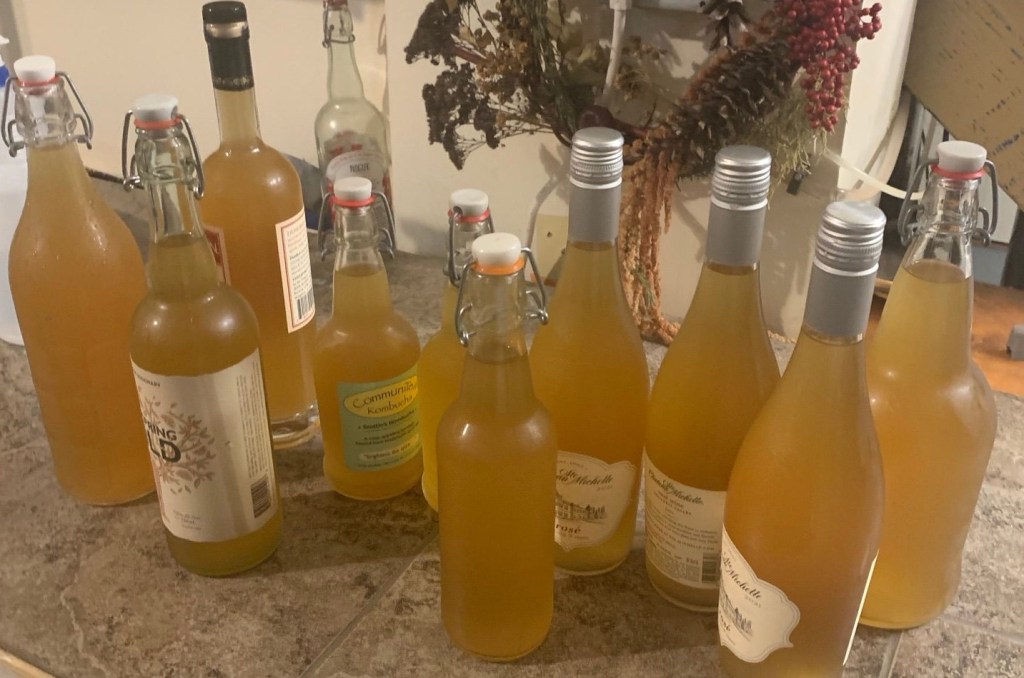
Sitting by my computer as I write is a glass of my latest batch of mead. Making honey wine is the one hobby I have that I swore up and down that I would never ever ever try to make a buck off of. Baking and writing went that way, rapidly turned into work or the job, and to an extent I lost a lot of what made them enjoyable as hobbies in the first place. Meadmaking is my excuse to create for the sake of creation- putting something into the world that didn’t exist before that I can take joy in creating, finishing, and then sharing.
A time-consuming but delightful and cost-effective method to acquire booze for home and gift-giving… making it yourself.Continue reading →
Whimsy isn’t something you have to earn- it’s something you possess and cultivate, and if you are drawn in a direction out of whimsy and authenticity you are too lucky to ignore it. That’s the kind of thing that shows you who you are meant to be.
At the bottom of the hill where my winery is located, there’s a little bar in a shopping plaza. They have decent beers and a few hard liquors to choose from, but they’re really more of a taproom than a full bar. All the same, they are the semi-official post-shift watering hole for cooks, servers, and occasionally office people in the winery. We’re all regulars by face if not by name.
When the beer offerings aren’t tempting me after a long day, I tend to go with whiskey. They have a few pricier bottles to pick from and their cheapest bottles I’d call “middle shelf-” whiskey’s that would be in the $30-$50 range if I got one for myself. Better than rotgut and bottom-shelf well whiskey, but not as speedy as ultra-premium brands. If I’m not feeling like Jameson’s “Black Barrel” expression or one of the slightly spendy local whiskeys, the Old Forester “Bottled-in-Bond” is a reliable choice with a couple small rocks in it.
It was an evening after a rough day. I got my little glass, sat down at a table outside facing in to the parking lot and up the hill, and decided to update the family that it was in fact That Kind Of Day.
My father sent back his approval. “Old Forester was your grandfather’s favorite. There was always a bottle in your grandmothers den.”
I stared at the little glass and thought to myself, “Finally, after 40 years, I’m turning into an Old Man.”
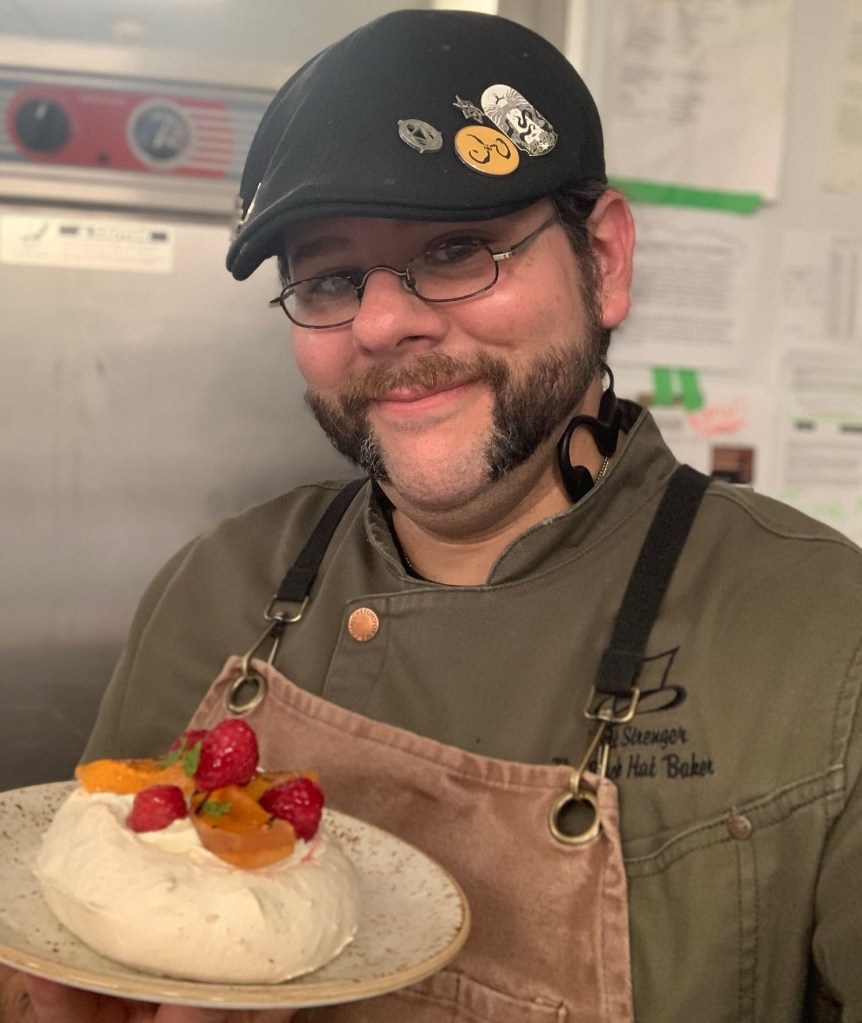
Pavlovas are a dessert that always impress for how simple they are. I have them on the brain right now because I’ll be making a couple dozen for a VIP dinner the day after tomorrow and I’m coming off a bit of an inspirational drought. I’m on the porch in the shade with a lowball of grog beside me and a cigar I may or may not smoke.
Named for the ballerina Anna Pavlova, they are giant baked merengue bowls filled with whipped cream and fresh fruit. If you’ve ever made angel food cake, macarons, or “forgotten kiss” cookies, you already know how to do the hardest bit. Pavlovas look so impressive and dainty, it makes people think they are difficult when the truth is they are a masterclass in Technique, Patience, Fresh Ingredients, and Not Getting Too Fancy.
Simple things are always like that. No space to hide when you fuck up a step. It’s a “you had ONE JOB” scenario, and how well you did that One Job is there on the plate. Overdone? Underdone? Cracked? Everyone’s going to see and then eat it anyway, because it’s sugar, cream, and fresh fruit that you worked hard on. In that way, pavlovas are a reminder that it’s all just food.
Writing can be like that too, I’ve found. You work at it, you pace it right, tease out the story, don’t outsmart your common sense, and hopefully you end up with something people will enjoy.
My boss and I had loosely discussed the VIP dinner dessert. The last dinner we did, he chose a riff on carrot cake because he knew it was the winemaker’s favorite and she would be in attendance. I did my best work on it and everyone loved it. Happy ending. The winemaker enjoyed it, but wondered if it really paired well with the wine that had been selected. I’d never gotten to taste the wine or even get notes on it, so the carrot cake was good… but overshadowed the wine at a VIP dinner at a winery. We could do better.
This time around, the winemaker showed me their advertising copy with tasting notes and poured me a little scoot to try. It was tangy, floral, and spoke of peaches and stone fruit. I jotted down notes in my phone along with her suggestion to avoid going too sweet, or the wine might taste sour in comparison. That’s easy to do with anything that isn’t “dessert wine”- ice wine, ports, or the kind of muscats you find glued to the lips of bridal shower attendees. A pavlova might actually be the perfect answer.
Initially, the boss and I had discussed a riff on another dinosaur Oceanic classic, Peach Melba. Instead of the poached peaches and raspberries on ice cream, however, my boss very much wanted a tart for the dinner. Tarts are easy to plate, clean to cut, and are easy to get cute with. Pile on the flavors, the textures, the colors, and a good cross-section will shine on anyones Instagram, hopefully tagged with the location and brand of the wine,
We both did trials of our tart ideas but neither quite fit the bill, and I kept assembling pavlovas in my mind. I’ve learned that some ideas won’t leave me alone until I take a crack at making them. Writing is a bit like that as well- you pay attention, and you’ll find a story worth telling the best you can.
The pavlova shell would be flavored with jasmine green tea. The herbal/floral scent compounding the flavors above and giving a bittersweet foundation- a blank sky for a flock of birds to be seen against.
I debated a diplomat cream filling- pastry cream lightened and folded with Chantilly- but decided even that would be too much. Pastry cream is a custard. Custard means egg. Egg is earthy, sweet, and grounding- a distraction. Instead, whipped creme fraiche with vanilla- a little sweet, a little sour, not too fancy, This and the shell would be vehicles carrying the fruit- important to do well, but no one marvels at the foundations of a house.
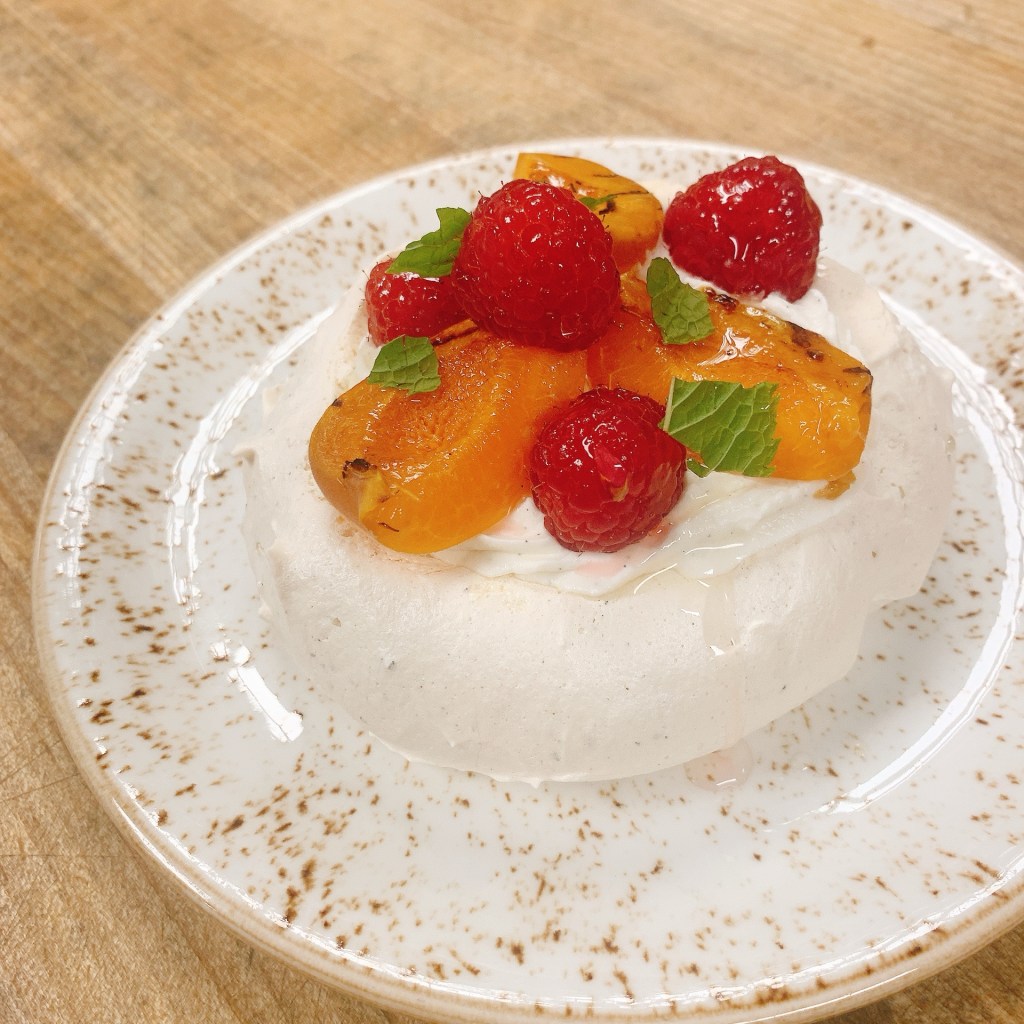
It would be Peach Melba inspired, like the chef and I agreed. Stone fruit was coming into season, and this would be what spoke to the wine. It would have to be gently handled. Highlighted. Elevated to stand out on the plate and point toward the wine. I imagined grilled apricots- another touch of bitterness in the char to caramelize the sugars and announce the sunshine in the golden flesh. Fresh raspberries are always good as they are.
You glaze the fruit on a plate. That’s just how it is. Cooks are craftsmen, and it’s our job to imitate nature and make it look like whatever we served you just grew like that. If there is fresh fruit on a plate, it needs to look like we just ran out to a garden and plucked a fistful of raspberries wet with morning dew from the bush. We have to make ourselves disappear in your mind when you look at the plate– wizards and elves and faeries just poofed this perfect plate of sustenance in front of you with no human hand intervening.
Glaze adds sweetness, but done right it can add more without drawing attention to itself. I imagined the berries and grilled apricots, shining in the light on the plate atop their hillock of whipped cream and egg. A little hill. On the hill up to the winery, I knew there was a honeysuckle bush- I smelled the blossoms every morning. Pungent, light, floral, fresh… I needed THAT on the plate.
Early one morning last week, the idea couldn’t live in my brain anymore, and I put it together. “Just make it happen, get it out of your head, and don’t fuck around.”
That’s why the VIPs this week are getting pavlova, you got to read about how it was made, and I have an empty glass beside me. Putting the right things together and putting the work in to treat them right means you’ll more often that not have something to enjoy.
Grilled Apricot Pavlova with Raspberries and Whipped Creme Fraiche
There are times when I walk into the winery kitchen in the morning, punch in, get to my bench, and my ritual feels a bit like rehearsing into a mirror in public. It’s for no one’s benefit but mine, and others either don’t care or pretend not to see and be curious. It’s still important because beyond the centering, grounding aspects of the act, it’s how I belong to myself.
The routine of the morning grows ignominiously but slowly. I come in, punch in, put my stuff down on the bench and decide what needs to be out and what needs to be in the locker. Going over the prep sheet and whiteboard is next. If something fucked up after I left the day before (or will fuck up without my immediate intervention,) that’s where I’ll find it. Make a plan for the day, then the coffee I’ll never drink. Check the covers for the day, then back to the office for emails on what amounts to the professional version of gossip. Very little of it has anything to do with me or requires my attention yet, and if things got really bad on the pastry station, that’s how I’ll find out.
Back to the kitchen. Temperature logs handed down by the higher-ups, then my ritual and work begins.
I put on my coat, check my tools, scale the first recipe, and consecrate what is still My Place in this world- laboratory, dojo, and sanctuary.
Not quite like that, but still an epic moment in the movie.Continue reading →